

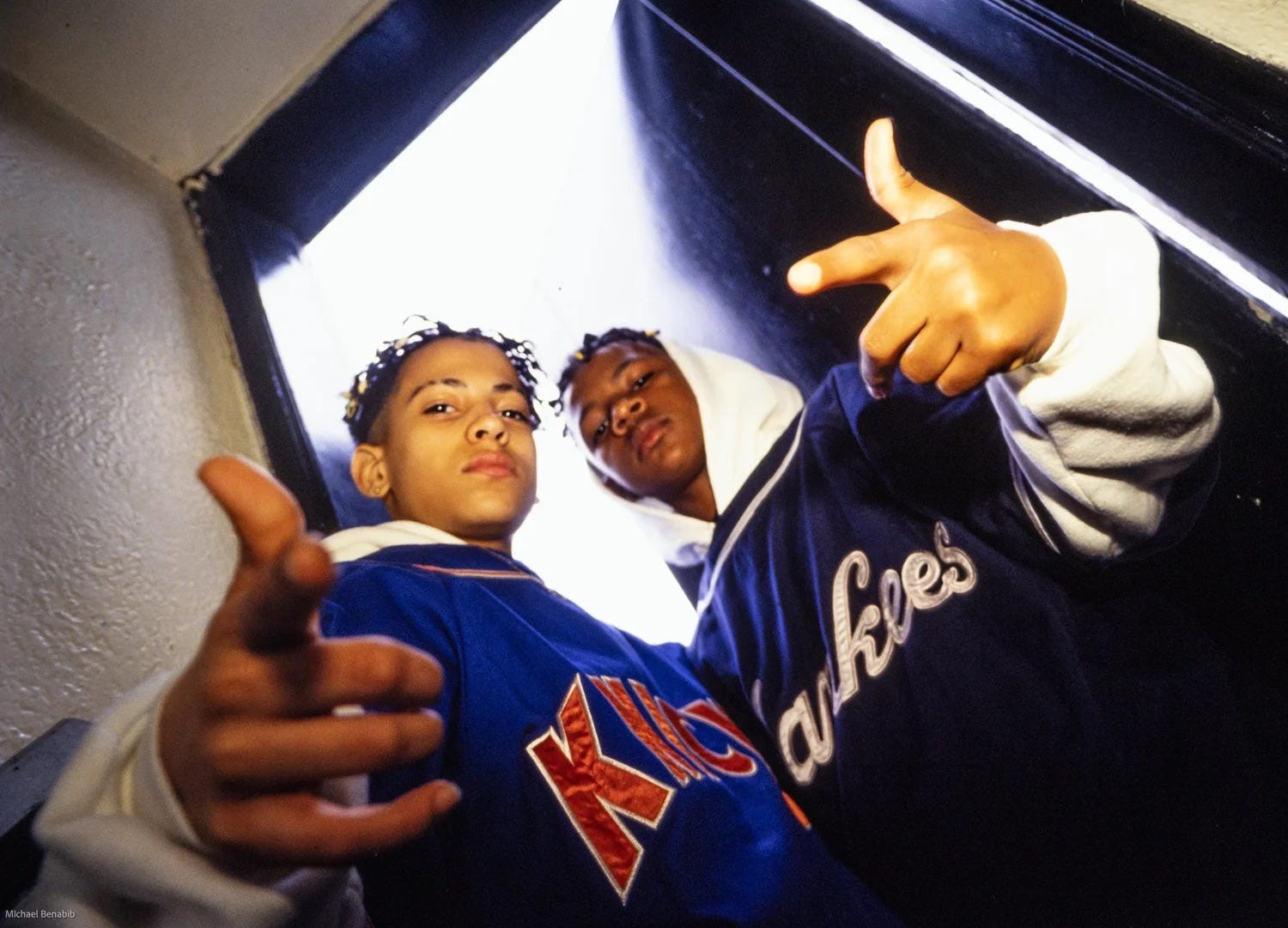
I recently introduced my little nephew (he’s 2) to Kris Kross, and he absolutely loves them. Watching him bounce around to “Jump” sent me down a rabbit hole, and I ended up learning way more about the duo than I ever knew before. What started as a fun moment with my nephew turned into a genuine appreciation for what Kris Kross represents in Hip Hop history and a newfound respect for Jermaine Dupri as a producer and songwriter. The man KNOWS talent. I mean, he did give us Da Brat, Xscape, and Lil Bow Wow.
Kris Kross was a young rap duo that debuted in the 1990s, a period when Hip Hop was still in its early stages of crossing over into mainstream American culture. The group consisted of Chris Kelly and Chris Smith (aka Mac Daddy and Daddy Mac), two stylish middle school-aged boys from Atlanta, Georgia. They were discovered, while sneaker shopping, by producer Jermaine Dupri, in Atlanta’s Greenbriar Mall in 1990 (some sources say 1991). After recognizing their charisma, confidence, and star potential, Dupri decided it would be a great idea to turn them into a rap group. It led to him developing the concept for their debut album Totally Krossed Out. The album, written and produced primarily by Dupri and Joe “The Butcher” Nicolo, spawned the hit “Jump,” which became the fastest-selling single in fifteen years at the time and remained at number one on the Billboard Hot 100 for eight weeks in 1992 (Kennedy, 2013). The follow-up single, “Warm It Up,” also reached number one. Two more singles, “I Missed The Bus” and “It’s A Shame,” followed with moderate success. The album itself reached No. 1 on the Billboard 200, remained at the top for two weeks, and stayed on the chart for a total of 65 weeks. It was later certified 4x Platinum by the RIAA, representing over four million copies sold in the United States.
Their youth made them non-threatening to mainstream radio audiences that had previously resisted rap music. This allowed Hip Hop to reach younger and more suburban listeners. Kris Kross became a fixture on radio, television, and music video networks, solidifying their place in popular culture. Their widespread visibility, chart success, and cultural influence mark them as a defining piece of the popular culture of the early 1990s.
Kris Kross can be analyzed through a semiotic lens by examining how their image, music, and fashion functioned as cultural signs during the early 1990s. They popularized the trend of wearing clothes backwards, a style that children across the country quickly adopted (Hip Hop Content, 2024). This fashion choice signaled youth rebellion, non-conformity, and playful defiance of adult expectations. These meanings were socially constructed through repetition in music videos, performances, and media coverage. Their success helped reshape how Hip Hop was presented to mainstream audiences by emphasizing fun, youthfulness, and accessibility rather than heavy aggression. Kris Kross contributed to the entertainment industry by helping to normalize child and teen performers in mainstream Hip Hop, paving the way for artists like Lil Bow Wow and Lil Romeo to be taken seriously. In terms of social representation, they presented young Black boys as creative, stylish, and commercially powerful figures, challenging pre-existing negative stereotypes.
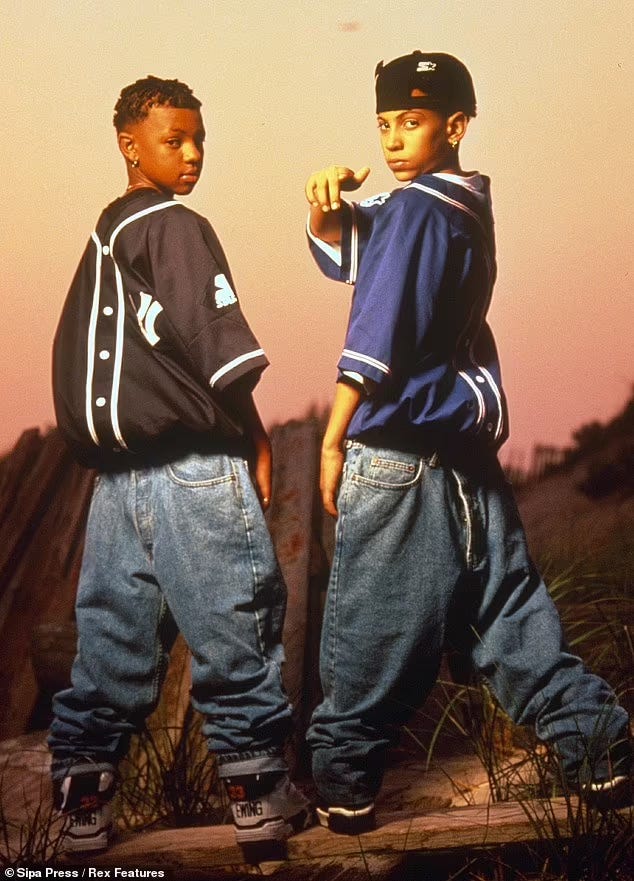
The primary audience for Kris Kross consisted largely of children and teenagers, though their appeal extended to adult listeners through mainstream radio and television exposure. Young fans interacted with the group not only by listening to their music but also by imitating their style, particularly their backward clothing, which became a visible and social form of participation. This transformed everyday fashion into a performative expression of fandom. While fandom during this era did not exist through online communities, fans expressed devotion through embodied activities such as schoolyard performances, dance routines, and reenactments of the group’s image. Merchandise, magazine features, and televised appearances further reinforced identification with the duo. Fan engagement was largely collective and social, occurring in classrooms, neighborhoods, and youth-centered spaces. Together, these behaviors demonstrate how Kris Kross’s fandom operated as a youth culture rooted in physical presence rather than digital interaction.
Media technologies played a major role in the production, distribution, and consumption of Kris Kross by extending their presence beyond music into multiple media formats. Television platforms like MTV helped popularize their image through music videos, while print media, live performances, and mainstream advertising reinforced their visibility and expanded their reach. Heavy rotation on programs such as Yo! MTV Raps increased visual familiarity and strengthened audience connection. In 1993, Kris Kross appeared in a Sprite television commercial, signifying their crossover into corporate branding and demonstrating how Hip Hop artists were increasingly used to market consumer products to young audiences. The group also became part of an early transmedia franchise with the release of Kris Kross: Make My Video in 1992, a video game that allowed fans to interact with the group through gameplay (Make My Video: Kris Kross,1992). This expansion into interactive media illustrates how emerging technologies deepened audience engagement. Media convergence blended music, fashion, television, gaming, and advertising into a unified cultural experience. In addition, Kris Kross toured internationally as an opening act for The King of Pop, Michael Jackson, using large-scale concert tours as another media channel to reach global audiences. Through international tours and music television networks, Kris Kross reached audiences across Europe, Asia, and other regions, contributing to the globalization of Hip Hop as a mainstream youth culture.
But what is Hip Hop without the beef? Going down this rabbit hole, it became clear that Kris Kross had real tension with Another Bad Creation and Da Youngstas. Listening back to the lyrics as an adult, it is obvious that they were dissing them, especially with the lyric, “Don’t try to compare us to another bad little fad...” Apparently, this stems from a beef between Jermaine Dupri and Michael Bivens, but that’s another story for another day. However, the beef went deeper than just Kris Kross throwing shade. The Philly duo Illegal came after Kris Kross hard on their 1993 track “We Getz Busy,” produced by EPMD’s Erick Sermon. Jamal Phillips and Malik Edwards were only thirteen at the time, but their music took on a harsh, bleak view of life that felt completely removed from Kris Kross’s lighthearted, mainstream-friendly vibe. Line after line, Illegal targeted Kris Kross with insults like “can’t write your own rhymes, sellin’ Jermaine’s life stories,” while also dissing Da Youngstas and Another Bad Creation. An article from The Boombox notes that “We Getz Busy” was their second diss track aimed at those groups and the only one of their songs to reach No. 1 on the Hot Rap Singles chart. The twist is that Illegal broke up just two years later, with both members eventually moving toward more commercial music. As The Boombox suggests, it is possible they launched those beefs because, on some level, their rivals embodied the success they craved for themselves.
Looking back at all of this with fresh eyes, thanks to my nephew’s enthusiasm, I have a whole new appreciation for what Kris Kross accomplished and what Jermaine Dupri orchestrated. They were not just a novelty act. They were cultural architects who helped mainstream Hip Hop reach places it had never been before, all while navigating the very real competitive tensions that make Hip Hop what it is. The story is also bittersweet because Chris Kelly (Mac Daddy) passed away in 2013, and it is heartbreaking to think about how much more he might have contributed to Hip Hop and popular culture. Rest in peace, Mac Daddy (1978-2013).
- Bisawonder
Sources
Breihan, T. (2012, January 12). The number ones: Kris Kross’ “Jump” Review of the song “Jump” by Kris Kross. Stereogum. https://stereogum.com/2172381/the-number-ones-kris-kross-jump/columns/the-number-ones
Channel 80. (2025, September 18). Kris Kross drops a freestyle on “Yo! MTV Raps” (1992) #kriskross #90srap #onehitwonder #freestylerap [Video]. YouTube.
Fuzzy Legends Archives. (2023, December 23). Kris Kross Sprite commercial 1993 HD [Video]. YouTube.
Hip Hop Content. (2024, February 21). The tragic story of Kris Kross [Video]. YouTube.
Johnson, A. (2025, January 18). Have you heard of Kris Kross? These 90s teen Hip Hop stars endured fame and tragedy. The Root. https://www.theroot.com/have-you-heard-of-kris-kross-these-90s-teen-hip-hop-st-1851741730/slides/7
Kennedy, G. D. (2013, May 2). Remembering Kris Kross’ Chris Kelly, and the power of “Jump.” Los Angeles Times. https://www.latimes.com/entertainment/music/la-xpm-2013-may-02-la-et-ms-remembering-kris-kross-chris-kelly-and-the-power-of-jump-20130502-story.html
Kris Kross – Totally Krossed Out Album. (2025). Discogs. https://www.discogs.com/master/102220-Kris-Kross-Totally-Krossed-Out
Make My Video: Kris Kross Video game. (1992). LaunchBox Games Database. https://gamesdb.launchbox-app.com/games/details/4802-make-my-video-kris-kross
Partridge, K. (2024, June 18). When Kriss Kross launched a backward clothing trend. Mental Floss. https://www.mentalfloss.com/entertainment/music/kriss-kross-backward-clothing-trend
safraducreay. (2018, July 18). Illegal’s Feud with Kris Kross + Other Groups: Was it Worth it?. The Boombox. https://theboombox.com/illegal-beef-kris-kross-we-getz-busy/